
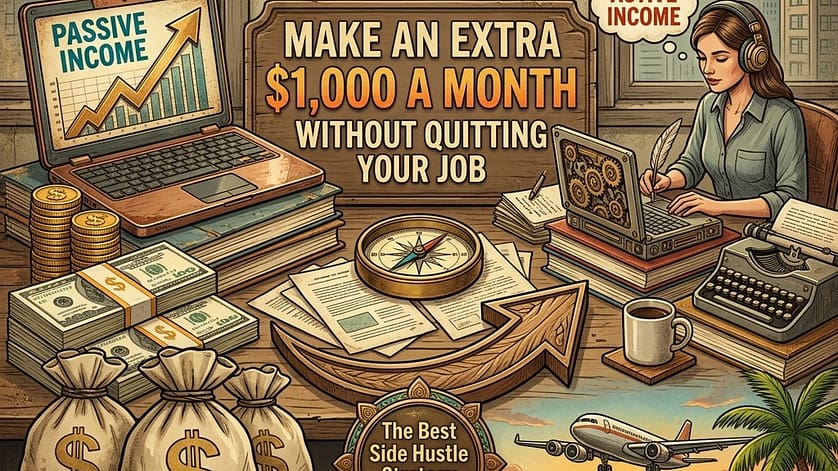
If you are currently working a 9–5 and feeling the squeeze of rising costs, you aren’t alone. Professionals across the U.S., UK, Australia, and New Zealand are increasingly realizing that relying on a single paycheck is a concentrated financial risk. In an era of shifting job security and rising inflation, the dream of “financial freedom” is often buried under the weight of daily responsibilities.
However, when you start looking for ways to build extra income, you often hit a wall of conflicting advice: “Build a passive income empire while you sleep!” vs. “Grind out freelance hours until you’re exhausted.” For a busy professional, the debate isn’t actually about which model is better—it’s about sequence. Here is the high-leverage framework for adding $1,000+ to your monthly income without burning out or risking your career stability.
The Hidden Trap of “Passive Income” Hype
Most people fail because they start with the hardest model first. They hear about blogs, YouTube channels, or digital products and spend six months working late nights with zero financial return. While these models are incredible once they work, they require a massive upfront investment of “unpaid” time.
Burnout doesn’t come from hard work; it comes from work without results. When you are already giving 40–50 hours a week to your employer, your brain has a very low tolerance for unrewarded effort. If you don’t see a “win” within the first 30–60 days, your motivation will likely crater. This is why the sequence of your side hustle matters more than the idea itself. You need a strategy that rewards your limited energy with immediate feedback.
Active Side Hustles: Trading Skill for Immediate Cash
Active side hustles involve performing a service or a task in exchange for a fee. For a professional, this usually means taking what you do during the day—whether it’s marketing, project management, or coding—and offering it to a different audience on your own terms.
The primary advantage of an active hustle is speed. It is the fastest way to put money in your pocket because you can often land a client and get paid within weeks. Because you are selling a “done-for-you” solution, the value is clear and the feedback loop is instant. The downside, of course, is that your income is capped by your hours. If you stop working, the money stops flowing. However, for someone looking to hit that first $1,000/month mark, this is almost always the correct starting point.
Passive Side Hustles: Decoupling Income from Time
Passive income is the ultimate goal because it allows you to build an asset once that pays you repeatedly. This includes digital templates, online courses, affiliate marketing, or even dividend-paying stocks. The allure is obvious: you make money while you sleep or while you’re at your day job.
The reality, however, is that “passive” is a bit of a misnomer. These businesses require a heavy lift at the start—often months of content creation, audience building, and technical setup before the first dollar arrives. If you are starting from a place of financial stress or total exhaustion, the long lead time of a passive model can feel like a second job with no paycheck. This is why passive income shouldn’t be your first step, but your second.
The “Margin First” Framework: How to Sequence Your Success
The smartest way to build a side hustle without quitting your job is to follow a three-step transition that builds momentum rather than burnout.
Step 1: Start Active to Create “Financial Margin” Your first goal isn’t total freedom; it’s breathing room. By starting with an active, skill-based hustle—like consulting in your current professional field—you can add $500–$1,500 to your monthly income almost immediately. This “margin” reduces your stress and provides the psychological boost of seeing real money hit your bank account.
Step 2: Reinvest Your Margin into Passive Assets Once you have an extra $1,000 coming in from your active hustle, you no longer need every dollar to survive. You can now afford to spend a few hours a week building a passive asset, like a digital toolkit or a self-serve course, without the crushing pressure of needing it to pay your rent tomorrow. You are building from a position of stability, not desperation.
Step 3: The Gradual Transition As your passive assets begin to earn $200, then $500, then $1,000 a month, you can begin to scale back your active freelance hours. Eventually, the passive income replaces the active income entirely. This is how you build an exit path from the 9–5 that is actually grounded in reality.
Conclusion
The secret to a successful side hustle for busy professionals is to earn first and automate later. By starting with an active, service-based hustle, you validate your value in the marketplace and gain the financial stability needed to build long-term passive assets. You don’t need a viral idea to change your financial trajectory; you need a sustainable sequence that respects your time and energy. Even an extra $1,000 a month creates a massive shift in your life—it pays for the car, builds the emergency fund, and most importantly, gives you back control over your future. Success in 2026 isn’t about working harder; it’s about working smarter by building optionality into your career one step at a time.